Working Paper
Orders from Above, Demands from Below: A Systems View of ...
Sep 27th 2026
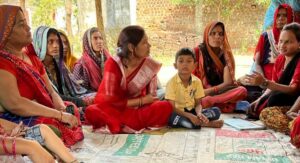
What does convergence of India's rural women empowerment programs entail?
Read More


 Michael Walton
 Siddharth Yadav
 Siddhant Gokhale
 Anishmita Barah
 Vivek Kaila
Sep 27th 2026
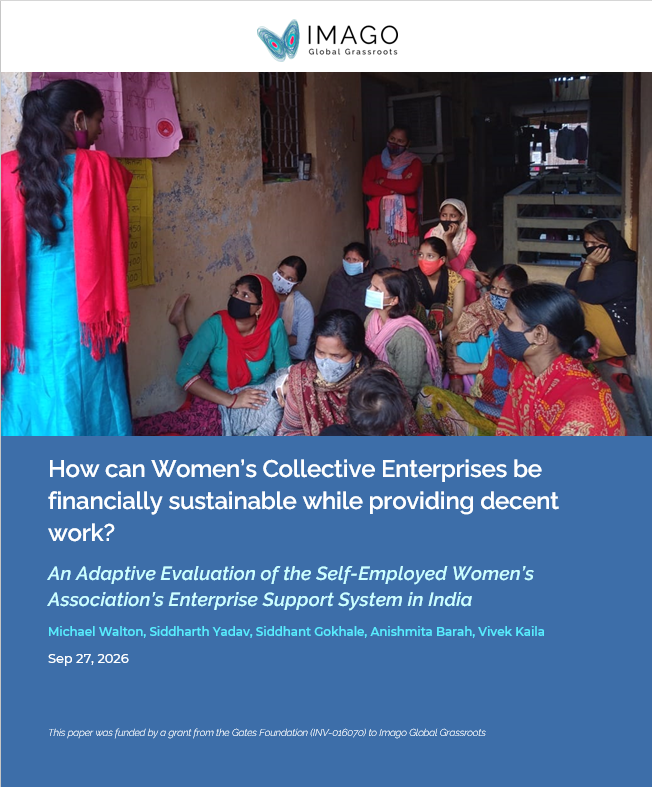
A link to the pdf of the full paper is here. Note this is a working paper.
Abstract: Can women’s collective enterprises be financially sustainable while providing decent work for women who are structurally excluded from the labor market? Such enterprises exist across India in large numbers, notably through the self-help group movement within the National Rural Livelihoods Mission. But most are nascent, and dedicated institutional systems to help them succeed as businesses remain rare. The stakes are high: India’s female labor force participation is among the lowest in the world, and recent evidence attributes this less to women’s unwillingness to work than to the scarcity of work they and their families find suitable—itself a function of norms on what is considered appropriate work for women. This paper evaluates the Women’s Enterprise Support System (WESS), an organizational innovation developed by the Self-Employed Women’s Association (SEWA) between 2019 and 2024 to support eight women-owned collective enterprises (WCEs), hosted in two institutional settings: the Gujarat SEWA Cooperative Federation and SEWA Bharat. Using an “adaptive evaluation” design that combines organizational diagnosis, process tracing of fourteen service offerings to individual enterprises, overall enterprise financial tracking and journeys, and three rounds of member surveys, we find five of the eight enterprises reached or approached financial sustainability, typically after three to five years of dedicated support. WESS’s services made a credible causal contribution in almost all traced cases; but WESS itself cannot be fee-financed. Member incomes rose where enterprises grew, and women valued stable income, savings, safety and recognition—the terms on which the labor market otherwise fails them.
———————————————————————————————————————————————–
Annexure I on process tracing the specific WESS service modules offered to the WCEs is here. Annexure II on the journey of the WCEs in this study is here. A presentation of the work presented in a joint event with SEWA Bharat on September, 24, 2026 is here.
This paper was funded by an evaluation grant from the Gates Foundation (INV-016070) to Imago Global Grassroots. Special thanks to SEWA Bharat and SEWA’s Cooperative Federation for their work. IDInsight for their collaboration on the quantitative surveys and analysis, and the Gates Foundation for financial support and guidance


Working Paper
Sep 27th 2026
What does convergence of India's rural women empowerment programs entail?
Read More
Working Paper
Sep 27th 2026
Can Women's Enterprise Support Systems help women's collective enterprises?
Read More
Brief
May 7th 2026
A friendly and practical introduction to Adaptive Evaluation
Read More
